Why do Google reviews matter so much for a local business?
When a customer searches for a plumber, a dentist, or a restaurant near them, Google shows a short list of businesses with star ratings next to each name. Most people look at those stars before they look at anything else. A business with 4.8 stars and 120 reviews looks safer than a business with no reviews at all, even if both do the same quality of work.
Reviews also help your Google Business Profile rank. Google wants to show searchers businesses that real customers trust, and a steady flow of fresh, genuine reviews is one of the clearest trust signals you can send. This is why reviews sit at the heart of my Google Business Profile optimization guide: they support both rankings and conversions at the same time.
For a broader background on how online reviews work, see the online review overview on Wikipedia. In short, reviews are word of mouth at search scale, and for a local business they are often the first impression a customer ever gets.
How many reviews do I actually need?
There is no magic number, but there are useful rules of thumb from what I see on real local profiles:
- More than your closest competitors. If the top three businesses in your area have 40, 60, and 90 reviews, aiming for 100 puts you in the conversation.
- A steady flow beats one big burst. Ten reviews spread over two months looks more natural, and more trustworthy, than ten reviews on one day.
- Recency matters. A business whose newest review is two years old looks inactive, even with a high overall rating.
- Quality matters more than perfection. A 4.7 rating with detailed, genuine reviews often converts better than a perfect 5.0 with three short ones.
Do not chase a number for its own sake. Chase a review profile that makes a new customer think: this business is active, trusted, and cares about its customers.
When is the right moment to ask for a review?
The best moment to ask is right after a customer is happy, while the experience is fresh. That moment is different for every business:
- After the job is finished. A plumber, electrician, or cleaner should ask as they hand over the finished work.
- After a successful appointment. A clinic, salon, or studio should ask at checkout, when the customer is smiling.
- After delivery or pickup. A shop or restaurant should ask when the customer has the product in hand.
- After a problem is fixed well. A customer whose complaint was handled properly is often your strongest reviewer.
Ask in person first, then follow up with a link. A spoken request plus a simple link in a text or email is far more effective than a link alone. Keep the request short, and never offer payment or discounts for reviews: Google removes incentivised reviews, and one removal wave can damage a profile badly.
What should I say when I ask for a review?
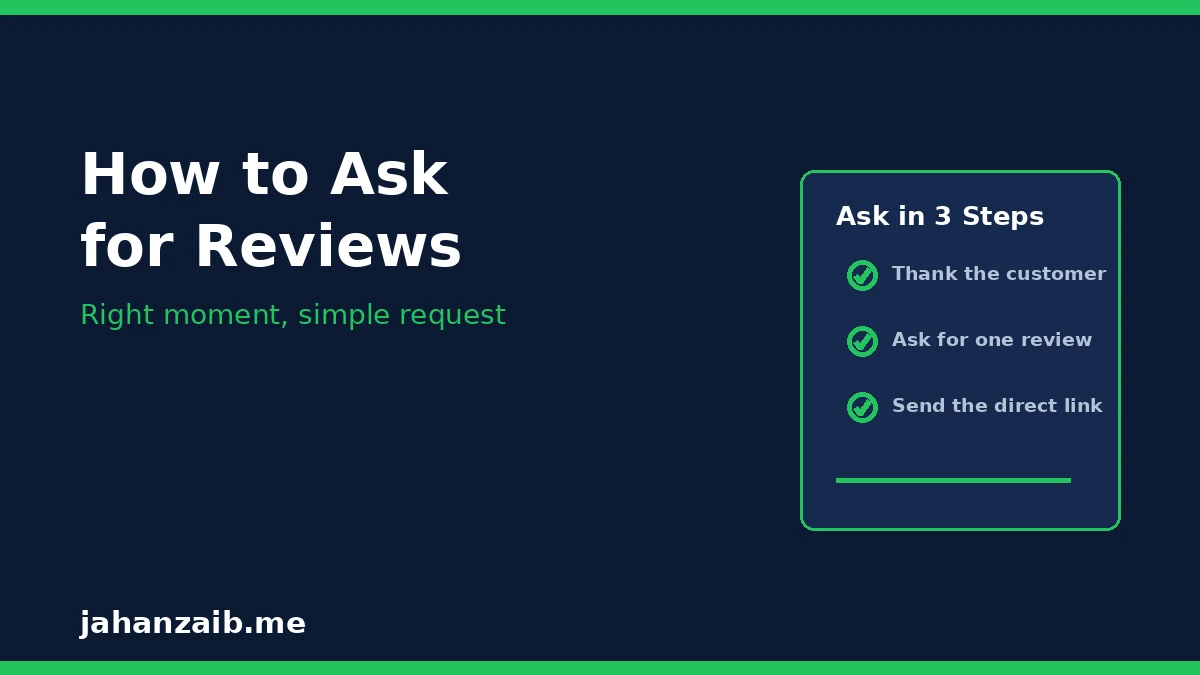
Keep it simple, personal, and specific. Customers respond to a real request from a real person, not to a generic template. A good ask has three parts:
- Thank them. Start with genuine thanks for their business.
- Ask for one specific thing. Ask them to share their experience on Google, not to “leave feedback somewhere”.
- Make it easy. Send your Google review link directly, so the customer needs one tap, not a search.
An example you can adapt: “Thanks so much for choosing us today. If you were happy with the service, would you share a quick review on Google? It really helps other local customers find us. Here is the link.” That is it. No long explanation, no pressure, and no script that sounds like a robot wrote it.
Make the link easy to find everywhere it belongs: on receipts, in follow-up emails, on your website, and in your email signature. The easier the path, the more reviews you will collect.
Should I reply to every review?
Yes. Every review, good or bad, deserves a reply. Replies do three jobs at once: they show future customers that you pay attention, they show Google that the profile is active, and they give you a chance to add useful information for the next reader.
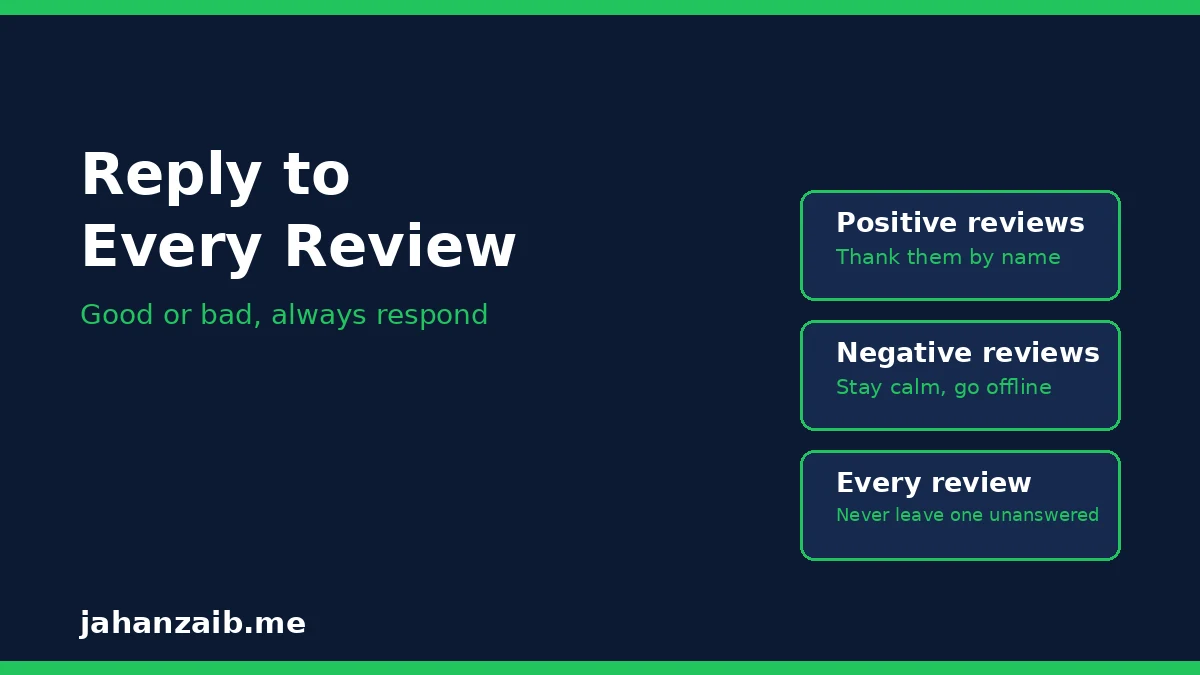
- Reply to positive reviews within a few days. Thank the customer by name where possible, and mention something specific from their review.
- Reply to negative reviews calmly and quickly. Thank them, apologise for the experience, and offer a real way to fix it offline, such as a phone number or email.
- Never argue in public. A defensive reply hurts you more than the original complaint. Take the detail offline, and keep the public reply polite and short.
- Never ignore a review. Silence reads as indifference, and future customers notice it.
A strong reply to a positive review might read: “Thank you, Sarah, we are glad the repair went smoothly. We appreciate you taking the time to share this.” Short, warm, and personal beats long and corporate every time.
How do I handle a negative review without making it worse?
A negative review feels personal, but it is also an opportunity. Handled well, a thoughtful reply can win over the next ten people who read it. Follow these steps:
- Pause before replying. Never reply while angry. A rushed reply is almost always a regretted reply.
- Thank them and acknowledge the issue. Even if you disagree with the details, acknowledge that their experience was not good enough.
- Apologise briefly. One sincere sentence is enough. Do not write an essay.
- Move the conversation offline. Share a phone number or email and invite them to contact you directly.
- Fix the root cause. If three reviews mention the same problem, the problem is real, and fixing it matters more than any reply.
What you must never do: offer payment to remove a review, post fake positive reviews to bury it, or accuse the reviewer of lying in public. All three backfire, and Google can remove fake reviews and penalise the profile.
If a review is genuinely fake, spam, or contains abusive language, flag it through Google’s review reporting process and move on. Most flagged reviews take time to be assessed, so a calm public reply in the meantime protects your reputation while you wait.
How do reviews help my Map Pack rankings?
Reviews support Map Pack rankings in several practical ways:
- Freshness. New reviews regularly signal that the business is active and still serving customers.
- Keywords in review text. When customers naturally mention your service or area, for example “best plumber in Multan” style wording in their own words, it reinforces what your business is known for. Never script this; genuine customer wording is what counts.
- Engagement. Owner replies show Google that the profile is managed, not abandoned.
- Trust and clicks. Higher ratings earn more clicks and calls, and that engagement itself supports visibility over time.
Reviews alone will not carry a weak profile to the top of the Map Pack. They work together with accurate business details, real photos, and consistent activity, which is why my Map Pack work always treats reviews as one part of a complete profile, not a shortcut on their own.
What are the most common review mistakes local businesses make?
- Never asking at all. Happy customers rarely leave reviews unprompted. If you never ask, your profile stays empty while competitors collect reviews.
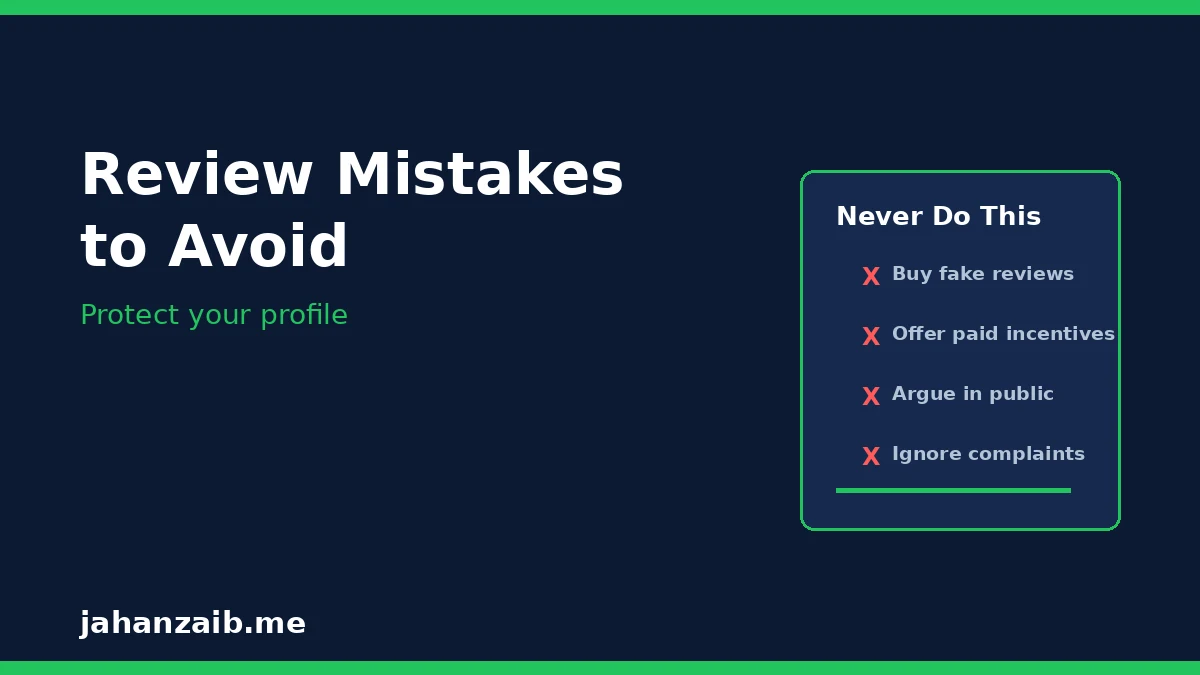
- Asking only unhappy customers to stay quiet, or only happy ones to speak up. Review gating, asking only satisfied customers for reviews, breaks Google’s rules. Ask everyone, equally.
- Offering incentives. Discounts, gifts, or payments for reviews get removed and can damage trust.
- Posting fake reviews. Fake reviews are increasingly detected and removed, and getting caught costs far more than it gains.
- Ignoring negative reviews. An unanswered complaint speaks louder than the complaint itself.
- Using one generic reply for everything. Copy-pasted replies tell readers you do not actually read your reviews.
- Stopping after a good month. Reviews need ongoing attention. A profile that stops collecting reviews slowly slides behind competitors who keep going.
What is a simple weekly review routine I can follow?
You do not need expensive software. A simple weekly routine keeps your review profile healthy:
Every day
- Ask happy customers in person, then send the review link.
- Check for new reviews and reply to any that arrived.
Every week
- Review the week’s new reviews for patterns: what do customers praise, and what do they complain about?
- Fix one recurring issue, even a small one, and note it for your team.
- Check your review count against your top three local competitors.
Every month
- Update your review link on receipts, emails, and your website if anything changed.
- Share a genuine positive review, with the customer’s permission, on your social media or website.
- Remind your team that asking for reviews is part of good service, not an extra chore.
This routine takes minutes a day, and over a year it builds a review profile that most competitors never match.
Need help building reviews that bring in customers?
If your Google profile has few reviews, old reviews, or unanswered complaints, you are losing customers to competitors before they ever call you. I can review your profile, show you where reviews are holding you back, and set up a simple, honest system for collecting more of them, starting with the steps in this guide.
Contact me here and tell me about your business. I work with small businesses in the UK, US, and Australia, and I will give you an honest assessment of what your profile needs.