If your business depends on customers in one city or neighborhood, Meta Ads (Facebook and Instagram ads) can be one of the cheapest ways to keep your phone ringing. But only if you run them the right way.
Most local businesses I talk to make the same expensive mistake: they boost a post, watch a few hundred likes roll in, and get zero new customers. Boosting is not advertising. Real Meta Ads are a different game, and this guide shows you how to play it.
I am Jahanzaib Shahzad, a Local SEO and Digital Marketing Specialist. I have managed paid campaigns on Facebook and Google Ads for local e-commerce businesses, and I work with Local SEO every day, so I see exactly how paid and organic work together. Below are the questions local business owners ask me most, answered the way I would answer them on a call.
How Do Meta Ads Actually Work for a Local Business?
Google Ads catch people who are already searching for what you sell. Meta Ads work the other way around. Nobody opens Instagram looking for a plumber or a dentist. Your ad interrupts their scroll and creates demand that did not exist a minute earlier.
That difference changes everything about how you run the campaigns:
- On Google, you bid on keywords. On Meta, you target people.
- On Google, the intent is already there. On Meta, your creative has to create it.
- On Google, the best campaigns win by relevance. On Meta, the best campaigns win by stopping the scroll.
For local businesses, Meta is strongest in two roles: bringing in leads through lead forms, and reminding past website visitors and social engagers to come back and book. Businesses that run both Google and Meta usually find that Google fills today and Meta builds tomorrow.
Should I Just Boost My Posts, or Use Ads Manager?
Boosting has exactly one job: getting a good post seen by more local people. It is fine for awareness, like promoting an event or a genuinely great customer story.
But for lead generation, boosting is a money trap. Here is why Ads Manager wins:
- You choose a real campaign objective (Leads, Sales, Engagement), not just “get more likes.”
- You control placements, budgets, and schedules per ad set.
- You install the Meta Pixel so Meta learns who actually converts, and finds more people like them.
- You exclude existing customers, so you stop paying to show acquisition offers to people who already bought.
Rule of thumb: boost for visibility, use Ads Manager for revenue.
Which Campaign Objective Should a Local Business Choose?
Meta offers six campaign objectives, and your choice tells Meta’s system who to find. Pick the wrong one and Meta will find exactly the wrong people, very efficiently.
For most local businesses, the short list is:
- Leads: the default pick for plumbers, clinics, salons, home services, and any business that wins quotes. Meta looks for people likely to fill in a form, call, or message you.
- Engagement: the right pick when you want conversations in Messenger, Instagram DMs, or WhatsApp. Great for businesses that close deals in chat.
- Sales: the pick for online stores and website bookings, but only once your conversion tracking is working properly.
- Traffic and Awareness: useful for driving store visits or launching a new location, but rarely the first campaign a small business should run.
The most common setup mistake I see is running a Traffic campaign when the goal is bookings. Meta then finds clickers, not customers. Match the objective to the action you actually want.
How Do I Target Only My Local Area on Meta Ads?
This is the targeting step almost everyone gets wrong. Meta’s system is smart in 2026, but you still have to set the geographic guardrails yourself.
Follow these steps:
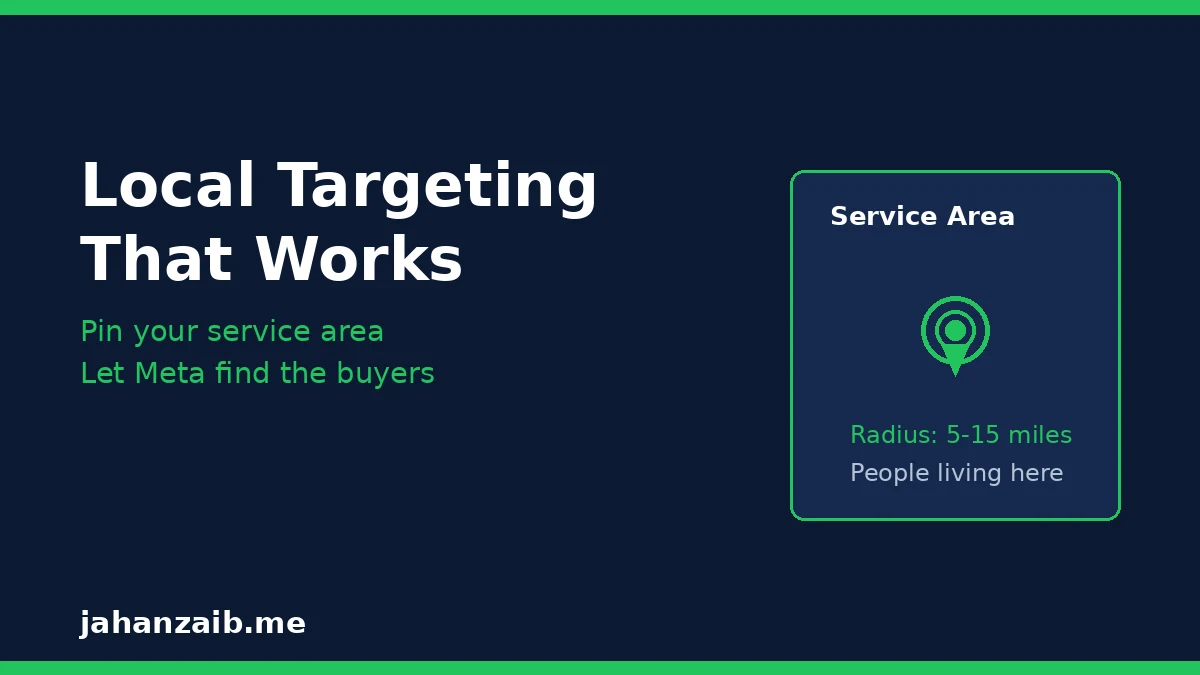
- Drop a pin on your business address in Ads Manager and set a radius, usually 5 to 15 miles (roughly 8 to 25 km) around your real service area. Start tight. You can always widen it later.
- Set the location behavior to “People living in this location” if you serve local residents (trades, clinics, services). Use “People recently in this location” if you want footfall too (restaurants, retail, salons).
- Keep the audience broad inside that radius. A small radius plus narrow interests makes the audience too small for Meta to optimize. Let your ad’s words and pictures do the filtering.
- Use Advantage+ audience as your starting point. You can give it suggestions like age or interests, and Meta will go beyond them when it predicts better results. Location and minimum age stay as hard limits.
- Exclude people who already converted or are existing customers, so your acquisition budget only chases new business.
What Budget Does a Local Business Need to Start Meta Ads?
There is no magic minimum, but there is a practical one: your daily budget must buy enough conversions for Meta’s system to learn. A tiny budget that never produces a lead never teaches the algorithm anything.
A sensible way to start:
- Pick one offer and one campaign, not five campaigns with a tiny budget each. One focused campaign beats five starved ones.
- Give the campaign at least 7 days before judging it. Judging day-two results is how good campaigns get killed early.
- Spend where the proof is: once a campaign is producing leads at a cost you can afford, scale that campaign instead of opening new experiments.
- Track cost per lead from day one, so “is this working” is a number, not a feeling.
I have run paid campaigns for local e-commerce businesses, and the pattern is always the same: small, focused, tracked budgets beat big, scattered ones.
What Ad Creative Actually Gets Local Customers?
In 2026, creative is the targeting. Meta’s system reads your ad’s images and words and finds the people who respond to them. So the creative does most of the work.
What converts for local businesses:
- Real photos and short videos of your actual work, your team, your shop. Before and after photos beat stock images every time.
- Vertical short-form video (Reels and Stories). This is where attention lives now, and Meta’s delivery favors it.
- One specific offer per ad. “Free inspection this week” beats “best quality service” every time.
- Your location in the copy. Name the city or neighborhood. It filters your audience better than any interest setting.
- Minimal text on the image itself. Heavy text on the creative cuts your reach.
Test at least 3 to 4 creative variations per campaign. The difference between a profitable and unprofitable campaign is almost always the creative, not the targeting settings.
How Do Meta Lead Ads Turn Into Real Quotes and Calls?
Meta’s native lead forms let someone request a quote without leaving Facebook or Instagram. That matters, because every extra step (open browser, wait for site, fill a long form) loses people.
To get quality leads instead of junk:
- Use the “Higher intent” form type, which adds a review step so casual tappers drop out.
- Add one qualifying question, like “What service do you need?” or “When do you want this done?”
- Keep the form short. Name, phone, and your qualifying question is enough.
- Connect the leads straight to your inbox, CRM, or phone notifications, and follow up fast. A lead answered in 5 minutes converts far better than one answered tomorrow.
- Call the lead, do not just email. Local service leads go cold quickly.

Do I Need the Meta Pixel or Conversion Tracking?
Yes, and this is the step most local businesses skip. The Meta Pixel (or the Conversions API) tells Meta who actually became a lead or customer, so the system can find more people like them.
Without tracking, Meta optimizes blind. It will happily spend your budget finding people who click but never buy. With tracking, every lead makes your targeting smarter.
Install the Pixel on your website even if you mostly use lead forms. The website visitors it collects become your best retargeting audience: people who already looked at your services and just need a reminder.
How Do I Know If My Meta Ads Are Actually Working?
Ignore likes and reach. For a local business, only a few numbers matter:
- Cost per lead: total spend divided by real leads. Compare it to what a customer is worth to you.
- Lead to customer rate: how many leads actually book. If this is low, the problem is usually follow-up speed, not the ads.
- Message and call volume: track how many quote requests, calls, and DMs came from the ads this week.
- Return per campaign: keep campaigns that produce, pause campaigns that do not. No sentimentality.
Review these numbers weekly, not hourly. Small daily swings are noise; weekly trends are signal.
How Do Meta Ads Fit With My Local SEO?
They are teammates, not competitors. Local SEO and your Google Business Profile win the customers who are searching right now (I wrote a complete guide to Google Business Profile optimization that walks through every step). Meta Ads win the customers who were not searching but can be convinced.
A simple local playbook that works:
- Your Google Business Profile captures high-intent searches: reviews, photos, accurate hours, real posts.
- Your Meta Ads create demand: lead forms, retargeting website visitors, local awareness.
- Both send people to a website with clear contact options and fast response times.
When both run together, every dollar works harder: Meta warms people up, Google catches them when they search, and retargeting closes the loop.
What Should You Re-Check Every Week After Your Meta Ads Go Live?
Meta Ads are not a set and forget job. A short weekly check keeps a small budget honest and stops a tired campaign from quietly eating money. Here is the five point check I run every week.
- Cost per lead this week against last week. If the cost climbs, check the creative first, not the budget.
- Lead follow-up speed. Look at how fast each lead got a call or message. Slow follow-up looks like bad ads, but it is really a bad process.
- Frequency and fatigue. If the same people keep seeing the same ad and results fall, rotate in one fresh photo or short video.
- Dead ad sets. Any ad set with no real leads after seven full days gets paused, and its budget moves to the ad set that is producing.
- Tracking health. Confirm the Pixel or Conversions API still records leads. Broken tracking means Meta optimises blind.
Updated 28 October 2026.
Ready to Get More Local Customers With Meta Ads?
You do not need a big budget or a marketing team. You need one good offer, tight local targeting, real creative, and tracking that tells you the truth.
If you would like a specialist to set this up properly, I help businesses run Local SEO and Meta Ads that actually produce calls and bookings. Get in touch through my contact page and tell me about your business.